
[Case Study] From Batteries to CO2 Capture to Cancer Treatment: What Patent Data Reveals About the Competitive Landscape of MOF Technology
TOKYO
(Translated from original Japanese article on VALUENEX’s official Note page)
A material that could change the world
One material drew particular attention following the 2025 Nobel Prize in Chemistry: the metal-organic framework, or MOF.
Decarbonization, electric vehicles, and cancer treatment may appear to be entirely separate challenges. Yet a single class of materials is being explored as a potential solution across all three.
MOFs are porous structures formed when metal ions and organic molecules bond together in a regular, repeating pattern, creating a material suffused with countless nanoscale pores. That combination of enormous surface area and structural versatility is what opens the door to such a wide range of applications.
You may be thinking, “Not another new material.” What makes MOFs distinctive, however, is that they are not materials designed for a single specialized purpose. Their versatility means they may be used for applications ranging from CO2 adsorption and battery electrode materials to drug delivery. Few materials offer such a broad range of potential uses.
So how far has the development race around this material progressed? An examination of patent data reveals several notable trends.
Where MOF technology stands today, according to patent data
VALUENEX, Inc. conducted a Radar landscape analysis of approximately 2,800 MOF-related patents, counted by patent family, published in major countries and regions worldwide over the roughly 20-year period from 2005 through the end of February 2025. The search covered patent information containing either “metal organic framework” or “porous coordination polymer” in the title, abstract, or claims. (Reference overview of MOF technology — Japanese)
Patents can provide clues about the direction of future technological development. Because companies and universities often file patents with future commercialization and product development in mind, patent activity can offer insight into where technological development may be heading. Looking across this landscape of approximately 2,800 patents makes the emerging directions of MOF technology increasingly clear.
One particularly striking trend is the pace at which patent activity has increased. Looking at annual trends by publication year, growth becomes especially pronounced from 2021 onward, suggesting that development has accelerated rapidly in recent years.
At the same time, even BASF, the largest filer, accounts for less than 4% of the total. This indicates that the field is not dominated by any single major corporation. Research institutions, including the University of California, also have a significant presence, suggesting that the field remains strongly rooted in research and development.
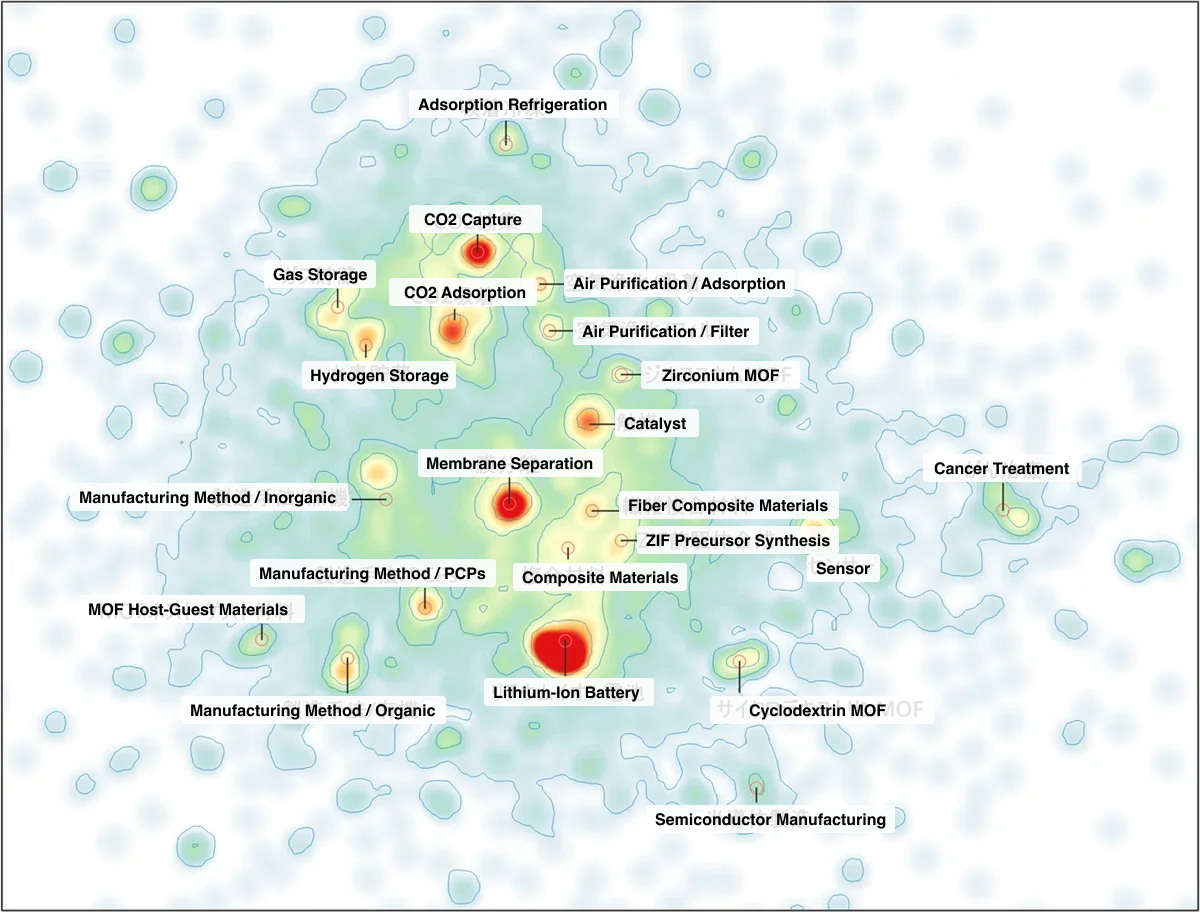
Overview map of MOF-related technology (Source: VALUENEX Patent Analysis Report)
Finding #1: A dual-purpose material for a decarbonized society
The areas with the greatest concentration of patents on the landscape are lithium-ion batteries and membrane separation, while CO2 capture and CO2 adsorption also show a substantial presence.
In the battery field, MOFs are being explored as electrode materials whose porous structures can facilitate the diffusion and insertion of lithium ions. Research is also underway into their use as solid electrolytes and as materials for capturing gases generated inside batteries. Expectations for MOFs are therefore growing in the context of improving the performance of electric vehicles and energy storage systems.
In the areas of CO2 capture and adsorption, attention is focused on the ability of MOF pores to selectively adsorb particular gas molecules. On the landscape, areas such as gas storage, hydrogen storage, and air purification (adsorption/filtration) are distributed around the CO2-related regions. This suggests that MOFs may also play an important role in contexts such as carbon capture and storage and hydrogen energy infrastructure.
In other words, MOFs may be used both to “store energy” in batteries and to “trap” CO2. This dual functionality is one of the key reasons MOFs are attracting attention as materials for the decarbonization era.
Finding #2: The frontier of medical MOFs — fighting cancer with light
One of the most visually distinctive areas on the landscape is cancer treatment, which appears somewhat like an isolated island, separated from the major battery and CO2-related clusters.
Yet MOF research into cancer treatment is very much underway. One notable approach is photothermal therapy — shining near-infrared light on MOFs causes them to generate heat and attack nearby cancer cells. Another is using MOFs as carriers in drug delivery systems (DDS), where the material's pores trap a drug and ferry it directly to cancer cells. The development of biocompatible "bio-MOFs" is what's made these medical applications possible in the first place.
Looking at the proportion of recent publications, meaning those published from 2021 onward, more than 75% of patents in the “cancer treatment” area fall into this recent period. Compared with fields such as batteries and CO2, which have accumulated research over many years, medical applications remain at an earlier stage. However, this figure indicates that research activity has accelerated rapidly in recent years.
Why are MOFs increasingly being explored for cancer treatment? For a more detailed explanation of the underlying mechanisms and related technology areas, please refer to the full report.
Finding 3: Driven by the AI boom? Unexpected expansion into semiconductors and fibers
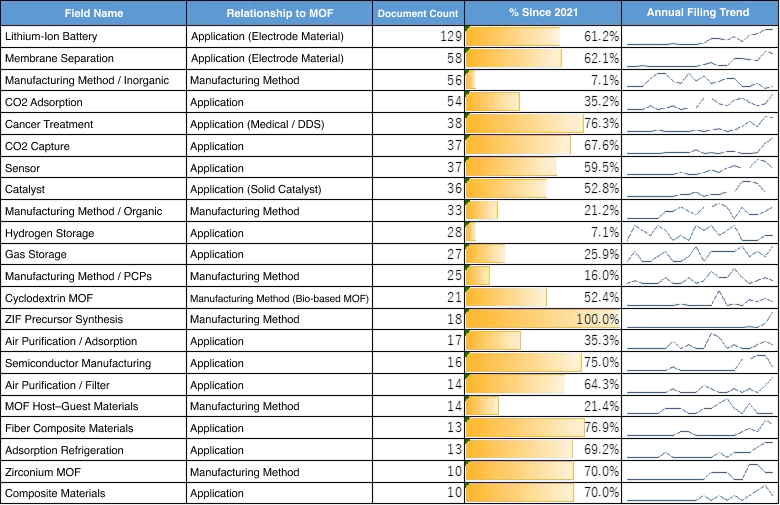
Summary table of each technology area related to MOF (VALUENEX Patent Analysis Report)
Cancer treatment is not the only area in which more than 75% of filings have occurred since 2021. A similarly strong concentration of recent filings can be seen in ZIF (Zeolitic Imidazolate Framework) precursor synthesis, fiber composites, and semiconductor manufacturing.
Semiconductor manufacturing is particularly noteworthy. While this is not a conclusion that can be derived directly from the present analysis, the recent surge in demand for AI semiconductors makes the expansion of MOF applications into semiconductor manufacturing an area worth watching. Semiconductor manufacturing requires highly precise control of gases as well as the adsorption and removal of impurities. MOFs’ selective gas adsorption capabilities may therefore prove useful in these processes. In fiber composites, MOFs may likewise be used to add functions such as adsorption and sensing to the material itself.
These are applications that may have fallen outside conventional expectations. Before examining the patent landscape, relatively few people may have associated MOFs with semiconductors or fibers. Yet recent patent trends suggest that the application frontier for MOFs is steadily expanding.
Emerging keywords such as nanosheets, biosensors, and RNA/DNA detection are also gaining attention. Careful analysis of the patent landscape can help reveal where the next major areas of competition may emerge.
For those interested in the full report
The full report provides more detailed coverage of the following:
A comprehensive landscape map covering all technology areas
A table showing the number of patent filings and the proportion of recent filings in each application area
Fourteen rapidly emerging keywords and an analysis of the factors behind their growth
A detailed overview of the competitive landscape, including a ranking of major applicants
Explore the Full Report
For those interested in understanding the full range of potential applications for MOFs, or in gaining insight into the latest developments in materials technology through patent data, we invite you to explore the full report.
[Free Report] “IP Landscape of MOF (Metal-Organic Framework) Technologies” (Click here to Download)
The analysis presented in this article was conducted by VALUENEX, Inc. based on patent data. It is not intended to constitute an investment recommendation regarding any individual company or security.
About VALUENEX Inc.
VALUENEX’s big data analytics solutions support the discovery of insights that can inform a wide range of business strategies by providing bird’s-eye-view analysis and visualization of large volumes of diverse textual information from around the world.
Our comprehensive solutions combine VALUENEX Radar, a SaaS-based big data analytics tool built on our proprietary algorithms, with consulting services backed by extensive experience in addressing a wide variety of management challenges.
Through these solutions, VALUENEX aims to contribute to industrial revitalization by accelerating research and development.